Pages

Thursday, 7 February 2013

Progress on Artefact 2 :)

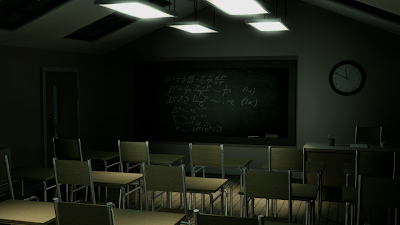
This week I have been experimenting with lighting again with my classroom scene, this time to create an atmosphere of an eerie night. So far, from using my previously posted reference images, I have decided to use photometric lights with a greenish/blueish tint (filter) to create the desired effect. I have also made some slight adjustments from feedback I received during my presentation for artefact 1, such as the time shown on the clock, slight bump maps on the walls, consistent backgrounds shown through windows.

Here are some renders I have edited in After Effects and Photoshop, experimenting with different colour tints and saturation:

Experiment with green tint - highly saturated

Experiment with green tint - desaturated

Experiment with blue tint - highly saturated
Experiment with blue tint - desaturated


So far, I think that more desaturated versions tend to show an eerie/uncomfortable mood more successfully, and also think that the green tints work slightly better. However, I will probably post these pictures onto a quick survey again to ask some simple opinions on them.

In order to investigate the role of colour when creating mood, I will also include a version which is almost totally monochrome from desaturation, to see if colour makes any difference or is actually needed to create this type of atmosphere. I have looked at film noir quite a lot during my initial reading into my research question, and this is a good example of how lighting can be used to enhance the atmosphere of the horror genre without any use of colour to influence this.

Experiment with hardly any colour saturation at all - Film Noir style

Wednesday, 6 February 2013

Modelling the Castle Walls

During my first week of making work for this client project, I planned to produce the main geometry of the 3 castle walls I have been allocated, which I think I have successfully completed. I have modelled each side of the building as a separate model for now, and will probably attach them later on if this is required. I have also checked the main wall measurements after Amanda informed me some were slightly off, therefore altered them as needed. I think I am going to email my progress so far and any questions I have to Simon (Hot Knife) tomorrow before or after meeting for tutorial, as he is in charge of the technical side of the project.

Anyway, renders/screenshots of the model so far!


Model with wireframe overlay (North Front end)


Model with wireframe overlay (South Front end)


Monday, 4 February 2013

Modelling walls again - Lower poly method!

I had just modelled most of the main geometry of the exterior walls of the castle, when I realised there was a better method to get less polygons, which was also a lot simpler. From looking at other low poly/game design examples, I discovered that creating basic divisions then insetting the polygons, instead of producing lots of divisions using the connect tool. The screenshots below the difference in polygons from my first and second versions of the East Front wall.


I also think that this method of modelling will be a lot easier for us to both follow the same structure, as I am not doing all 4 sides of the building. I have so far completed most of the exterior geometry as before, and just need to add the balcony areas, specifically on the South Front wall with the archways.

East Front wall with wireframe overlay

South Front wall with wireframe overlay

North Front wall and basement with wireframe overlay

Friday, 1 February 2013

Artefact 2 Planning


Artefact 2 - "Eerie Night"


"Lighting in the computer gives you the control to create any situation you can imagine. By using the right combination of intensity and color, you can effectively create a mood for your cinematic masterpiece."
(Ablan, 2003, p.78)


For my second artefact, I will continue to explore using lighting design as a technique to create mood and atmosphere. As I have already tried to use lighting to create the effect of a winter morning (natural light), for my second artefact I will focus more on creating a specific mood using artificial light sources during the evening or night time.
The types of mood and atmosphere I want to achieve are:

  • Dark
  • Cold
  • Gloomy
  • Creepy
  • Eerie
  • Uncomfortable
From looking at these moods and how others has portrayed similar atmospheres in CG lighting, I have found the following visual research so far...


From observing these examples, and from reading my research of this particular area, I can see that the following properties are needed to create such mood:
  • High key-to-fill ratios - bright lights, dark shadows, high contrast
  • Dark feel to environment not in focus
  • Green hue to lights and surroundings (sometimes blue)
  • Moonlight can be used to add to mood/darkness


Wednesday, 30 January 2013

Starting to Model the Castle (Ahh!)

Today, as I had finished my presentation the night before, I decided to try and make a start on modelling the castle, although I had no idea where to start! Eventually I decided to begin with the most complicated bit - the East Front wall. I am going to model each wall separately for now, mainly due to it enabling me to use the symmetry modifier - a lot easier! I have experimented modelling a few different ways (i.e. starting again a lot), but have settled on extruding inwards for windows, after realising that deleting the polygons altogether wouldn't allow me to texture them.

Anyway, here is all I have done in a last couple of hours - just the main shape and windows of the wall, and the start of the main body of the stairs (without the steps at the moment)...


Tuesday, 29 January 2013

Completed Mock-up Models

I completed the previously posted simple mock-up of the basic exterior outline of the castle in 3ds max, which I suggest that we all use as a guide when starting  modelling each part of the scene. This is modelled from the 1800 floor plan as a guide, using accurate measurements in cm which I figured out.


I have also done some practice of low poly modelling for my client presentation this week, using part of one of the pillars as an example. I have used as little polygons as possible by deleting all the back faces that are not needed and will not be seen when placed against the building. :)


Monday, 28 January 2013

Artefact 1 "Morning After Dark" - Development and Evaluation

Development/Improvement of Images:


Final Images:


Evaluation:

The aim of my first two research artefacts was to question the popular assumption/theory that lighting is the most important factor when it comes to visual storytelling. My first artefact, specifically, was to explore the techniques involved in using lighting design alone to show a CG environment at a certain time of day and year – a winter morning. Through quick feedback from online sources and the small focus group in my presentation, I would discover how successful this can be and what atmosphere it may create for the viewer.

The main information that can answer my initial enquiry from the results from this first artefact is that, although lighting plays a very important role, other elements are also often needed to emphasise the specific atmosphere that you are trying to create. For instance, although I only received small amounts of anonymous feedback on my original rendered images, I knew instantly that I needed to tone down the lighting intensity and use other techniques to enhance this experiment. This could be achieved by adding other clues to the winter morning theme, such as using imagery for exterior window textures with snow and colder colours, or using post production and colour correction techniques.

The feedback I have received from my focus group during my presentation was mainly based on attention to detail to improve the quality and believability of the scene....

  • Consistency in features - e.g. primary school decorations, secondary school style - which one?
  • Ambient occlusion would make it feel softer and more realistic
  • Bump maps on the walls could add more detail and make it less flat
  • The volume light effect was very sharp and solid, perhaps use noise parameters to make it more believable?


From completing this first artefact I have also learned how lighting and colours can be perceived totally differently by other people in comparison to my own personal feelings. Therefore, I have realised that intensive research and feedback is always important when trying to mimic a specific time of day or year with lighting. I have also realised that using different renderers, textures, and types of light can easily affect the success and quality of the outcome, and that it is good to experiment with these in conjunction with post production techniques in order to gain a totally successful outcome.